Showing posts with label Books. Show all posts

Sunday, December 10, 2017

This Year in Book Reviews

This post is on all the books I read this year.

The Palace of Illusions - Chitra Banerjee Divakaruni

The palace of illusions was a fine novel. I was apprehensive about yet another take on our epics. But this book did not disappoint. The language was very simple but not amateurish. The narration kept me hooked and I was rifling through the pages a lot. It was very enjoyable to hear Mahabharata from the point of view of Draupadi.  While many retellings vilify her for laughing at Duryodhana's confusion, this version has an interesting take on it.

The Rise of Sivagami - Anand Neelakantan

Yet another book by an Indian author is on this list. Fueled by the Baahubali craze I purchased this book. I particularly enjoyed Kattappa's origin story. I'm extremely excited to know how the plot thickens. This is a prequel set in the immersive universe. Sivagami's character is definitely one of the most intriguing in the movies and the book does not disappoint.

Women at War - Vara Hildebrand

A non fiction book is next on my list. It described the all-female regiment that served in Subhash Chandra Bose INA. Though they never actually fought, this book describes their trials, tribulations and their mindsets quite eloquently. There is a wonderful authenticity through photographs and interviews that you picture yourself being led by Capt. Lakshmi.

The Count of Monte Cristo - Alexandre Dumas

I revisited this particularly riveting tale in its original avatar. This is a story of the most romantic revenge. There is something in human nature that is immensely attracted to the age old tale of good defeats evil. Edmond Dantes, the highly successful sailor, poised to marry his sweetheart gets thrown into jail by jealous rivals in career and love. The prosecutor might have saved him but due to personal reasons, he keeps him in jail. Edmond, being a simple trusting person, believes he does not have enemies and languishes in prison. Withering away for fourteen long years, he strikes upon a magnificent treasure and rewards those who helped him and takes ruthless revenge on those who wronged him. He leaves the reader with the enigmatic statement for all the problems in the world - "Wait and Hope"! Do give this book a try.

Career of Evil - Robert Galbraith

This is a fast paced thriller by JK Rowling under a pseudonym. I enjoyed the style, a refreshing difference from the Harry Potter saga. Cormoran Strike, a private investigator, is sent a nasty mutilated leg in the mail. More disturbing is the fact that it was addressed to his secretary. It's a  fascinating tale of logic, drama and the society in its most real perspective. This is a thriller you would not want to miss. 

The Prince - Nicholas Machiavelli

One of the most translated Italian books, Machiavelli could be loosely seen as the Chanakya of medieval Italy. In a desperate bid to gain political favour, Machiavelli describes practical requirements of leadership sans all morality. Far ahead of its times, it describes why the global leaders acquire technologies, why good leaders have good reputation even if they have to do a task that is not palatable. This is a fascinating read for insights into human psychology.

Now there is a book store in my college and I have to go see if my list is to be edited later :)

Thursday, November 17, 2016

Book Review : Untitled by Gayathri Prabhu

A random purchase based on no recommendation or inclination, "Untitled" became yet another book to make itself home in my bookcase.

I had also bought "To Kill a Mockingbird" earlier and was planning to write a book review on that. As masterful as that book is, the whole world knows about it. This book on the other hand lit the wick of my imagination much like the embers in the lamps of the house of Wodeyar women.


This is a historical fiction set in the times of Tipu Sultan. The protagonists are two painters - Richard, an English artist and a Brahmin boy Mukunda who is drawn to art rather than the art of reading planetary movements.

The author beautifully brings out the many facets of Tipu Sultan - the ruler, the strategist, the merciless and the merciful. The book moves at a fast pace. From Richard's arrival in Madras to his reception in Srirangapatinam, we learn of the turmoil he faces. India, like it was for many Englishmen, was his coming of age story.

We also get a glimpse of the society's rebel - Mukunda. As the son of an astrologer, one expects him to docilely comply with the promptings of fate. But here is a boy who believed destiny was his own making.

My favourite character is Suhasini, the dark daughter of a fair priest, her intelligence knew no bounds. She is cunning, manipulative and charming. Her strong personality comes to life with the author's choice of words. She becomes the trusted informant of the Wodeyar Queen who was imprisoned. 

The book is replete with historically accurate information. It truly transports the reader to another time. An era where the king relied on both strategy and astrology. An era where Indians were not yet viewed with the loathing that will come after the First War of Indian Independence in 1857. An era where communication could take months. 

Yet, some things were timeless. The earnest will of the soul to not conform be it Richard, Mukunda or Suhasini. The absorbing nature of passion and art. The fact that there are no real victors in a war. The fact that humans can become animals when there is nothing to lose and there is no accountability.

This book is worth your time. The prose is almost poetic. If I had to find a flaw, I'd say I found it unbelievable that all the main characters had such a fine instinct about the uncertain future.

The subject is close to my heart. A trip to Mysore had prompted me to churn out this historical fiction. I felt like I visited the same places, but in another time. Do buy this book :)


Saturday, July 11, 2015

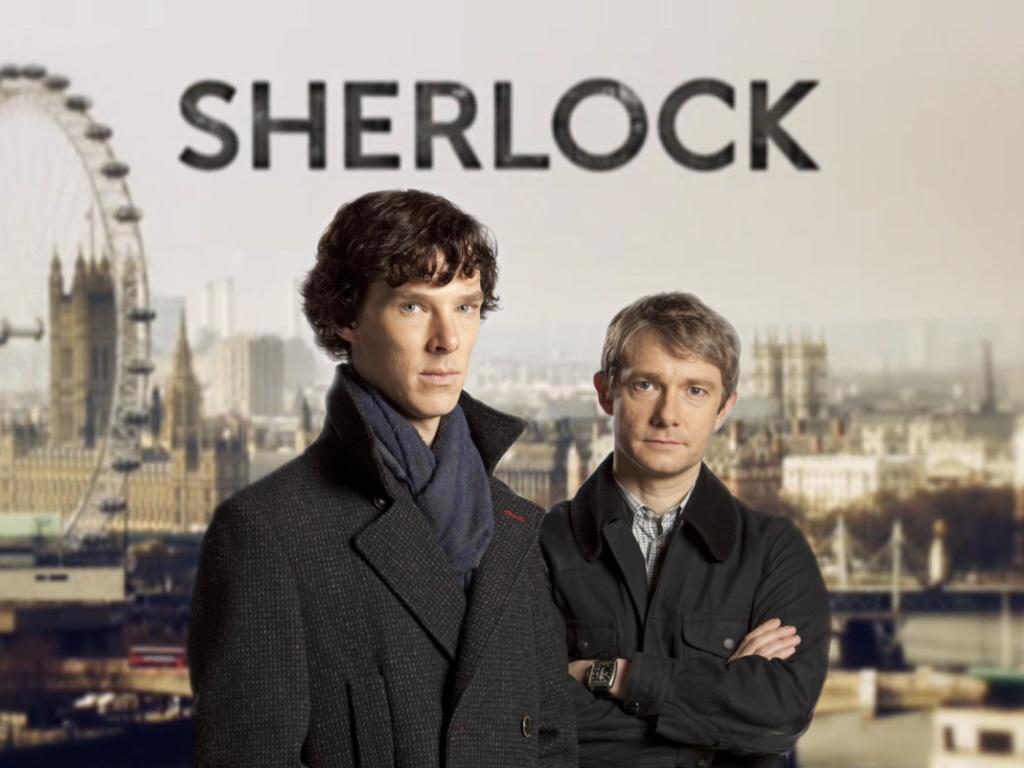
Book Sherlock vs. the Series Sherlock

Sir Arthur Conan Doyle would be have thoroughly enjoyed the hugely popular TV adaptation. I wrongly assumed the series would be totally unlike the original. The juxtaposition of the quaint 1800's where "cabbie" referred to horse drawn carriages to taxis was quite unnerving to say the least. At the same time, it made the genius of Sherlock to the general public.


To give you a perspective on how mind-boggling it is for a Sherlock Holmes fan to follow the series, I'm going to cut/copy/paste something from Wikipedia about the third episode in Season 3, "The Great Game".


  • Sherlock's surprising ignorance, discussed on John's blog, about several commonplace subjects including astronomy, comes from A Study in Scarlet.
  • Holmes' annoyance, about ordinary people filling their minds with useless subjects and unable to use their brains in the right errand, also comes from A Study in Scarlet.
  • Andrew West, the name of the MI6 clerk, comes from "The Adventure of the Bruce-Partington Plans", in which the victim is called Arthur Cadogan West; the idea of the culprit being the brother of the victim's fiancée appears in "The Adventure of the Naval Treaty". The Bruce-Partington Plans are also referenced in Sherlock's final blogpost before meeting Moriarty at the pool.
  • When Sherlock asks Watson what he thought about the trainers, that is clear reference to a scene early in The Adventure of the Blue Carbuncle where Holmes asks Watson to deduce what he can about Mr Henry Baker's hat in the original story.
  • The pink mobile phone receives messages with Greenwich Pips, with their numbers decreasing with each message, pointing towards "The Five Orange Pips".
  • The investigation of the death of Connie Prince resembles "The Adventure of the Retired Colourman", especially Watson's idea about masking tetanus with calcium hypochlorite on the cat's paws and Holmes reading internet forums to gather information about the TV star's relatives.
  • The conversation between Holmes and Moriarty in the final scene mirrors and quotes the confrontation in Holmes' study in "The Adventure of the Final Problem".
  • The "thick Bohemian paper" comes from "A Scandal in Bohemia", as does the scene where Sherlock notes Molly's weight gain.
  • Sherlock's statement "I'd be lost without my blogger" echoes his "I am lost without my Boswell" from "A Scandal in Bohemia".
  • Holmes' network of homeless persons who help him locate the Golem are referred to as his "eyes and ears all over the city", similar to the Baker Street Irregulars who appear in many of the Sherlock Holmes stories.
  • Sherlock firing a gun at a smiley face spray-painted on the wall at the start of the episode and the holes left in the wall is a reference to "The Adventure of the Musgrave Ritual", in which "Holmes, in one of his queer humours, would sit in an armchair... and proceed to adorn the opposite wall with a patriotic V. R. done in bullet-pocks".
  • The scene where Watson examines the shoes resembles a scene in "A Case of Identity" where he tries to deduce information about Miss Mary Sutherland. Sherlock's remark that Watson "missed everything of importance, but...hit upon the method" is also from the same story.
  • The conversation between Holmes and Watson after investigating the house of Connie Prince, where the former says, "We have to do some burglary", is from "The Adventure of Charles Augustus Milverton".
Clearly, the author of the series is one of the biggest fans of Sir Arthur Conan Doyle. To weave together so many dialogues and characteristics from the 200 odd stories is definitely the work of an obsessed genius.

Sherlock Holmes

The book Sherlock Holmes is a bit more dignified, just ever so slightly. However, the arrogance and the "Science of Deduction" has been portrayed most brilliantly. I loved the screenplay where they flashback and show his thought process. Some of the thought processes were a bit expected for me, but most were improvised and fantastic. 

Mycroft Holmes

I was a bit disappointed that Mycroft was introduced in the very first episode. There is a certain thrill when Watson discovers a man infinitely smarter than Sherlock but lacks the dexterity Sherlock possesses. I felt the genius of Sherlock had not been established well enough to ready the audience for Mycroft.

Moriarty
Similarly, Moriarty's involvement with Sherlock comes much later. Moriarty is a bit of an enigma in the books, with his physical features being described almost after a dozen stories that mention him. So, it was definitely a weird experience to see Moriarty in the flesh.

Dr. John Watson
I believe this was the character that was depicted most accurately. An intensely loyal worshipper of Sherlock and his methods, A brilliant man himself but not quite in the league of Sherlock. He published books/blogs on the science of deduction used by Sherlock. 

Lestrade
Ah, the bumbling inspector Lestrade. Who cannot sympathise with him? From the book, I imagined him to a young energetic man, but that was obviously an error considering he is the head of Scotland Yard!

In all, the series Sherlock Holmes is a must watch for any fan. Though it may make you cringe at some points, they are remarkably less than the avid book fan would criticize a screen adaptation. 

Get Deducing!


Sunday, May 3, 2015

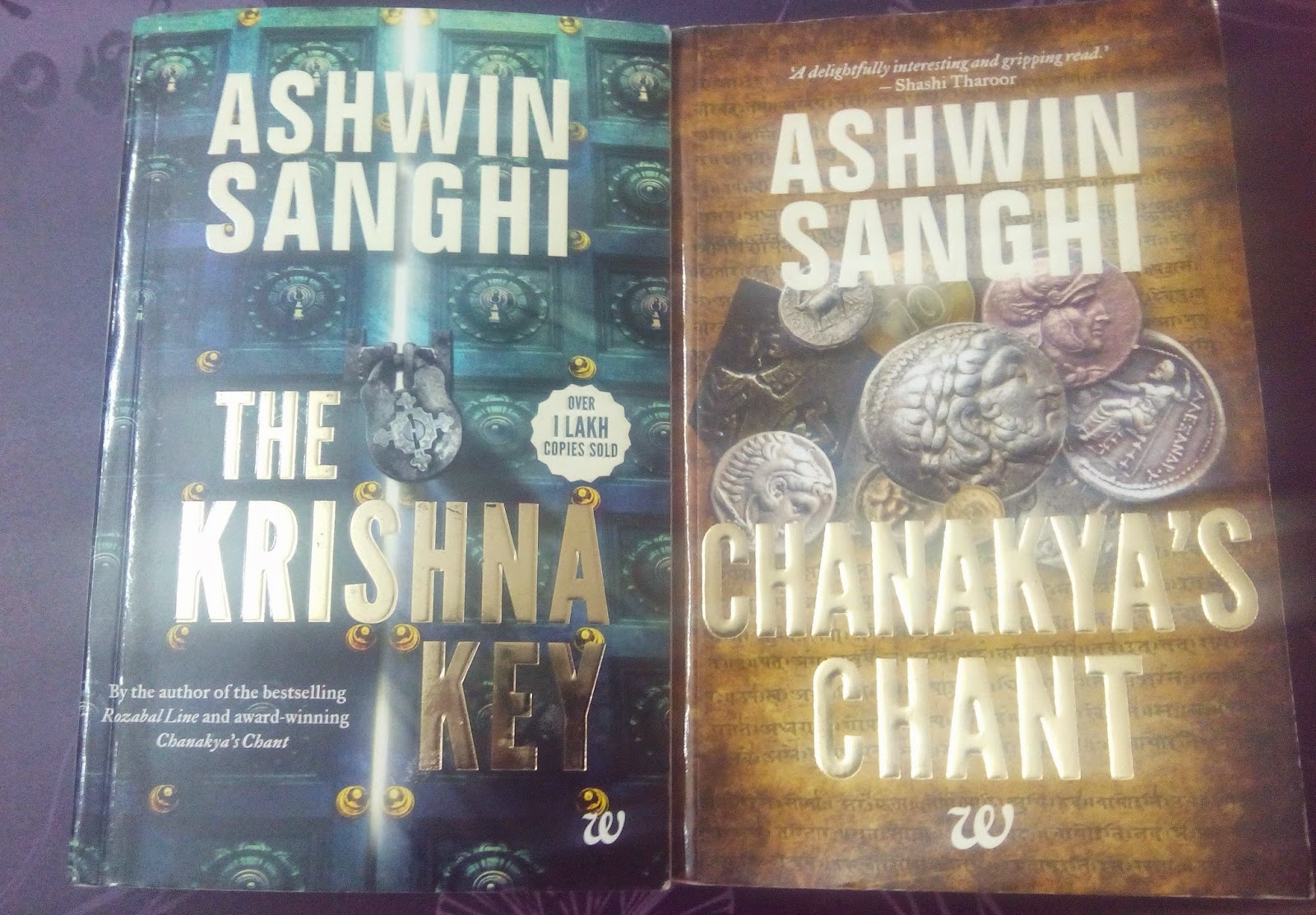
Ashwin Sanghi : Double Book Review

In April, I bought two books - Ashwin Sanghi's best-sellers - the Krishna Key and Chanakya's Chant.


I read Chanakya's Chant first. A mind-boggling thriller about two extremely shrewd and successful political operations - one in India years ago and the other in an India that has just won it's independence. The story oscillates between these two stories providing a well-written glimpse into the political acumen of both the protagonists - Chanakya and Gangasagar. Both of them designed a ruler to hold India together - Chandragupta Maurya and Chandini. This story is not for the faint-hearted. As the story proceeds, it keeps you on the edge. The historical facts intertwined with fiction is quite beautiful. I knew Chandragupta Maurya had female body guards. Hats off to the author for converting that one-line fact into an interesting story about Vishakanyas, maidens who could tolerate poison and whose bite would kill. Even though the narrative kept shifting between the plots, it was very enjoyable. In the end, the reader also savours the success of the protagonists.

Krishna's Key is about the tenth avatar of Vishnu, Kalki. While Chanakya's Chant drove mostly from history, this is from mythology. The story of Krishna and present-day murders intertwine. As I read the story, I could not help getting strongly reminded of Angels and Demons. 4 people died with a mark triggered that feeling. This is also a very well-researched novel. However personally, I did not find the magic of the previous book. However, it was kind of like an Indian Indiana Jones adventure. The climax was profoundly philosophical but left the adventurer in me feeling - four murders for this?

In all, the books are gripping and thrilling. Personally, I liked Chanakya's Chant better. Ashwin Sanghi has amazing talent and his writing is engaging.

Friday, December 26, 2014

Kurukshetra: A book review

As such, I'm a huge fan of stories. The takeaway of the story Kurukshetra, by Krishna is a political, emotional and social issue, where everyone tries to do the right thing but end up hopelessly compromising the lives of those who trust in them.


The hero of this telling is Govinda and the heroine is Panchali. Govinda is life whereas Panchali signifies death. Govinda is a character I have always struggled to accept. In essence, how can someone so naughty and shrewd be so benign and wise? This is the first book that has appealed to me so much because Govinda here is a very possible and a very lovable person, a person who I might be insanely interested in. Govinda represents what I seek in life so badly and what gives me ultimate bliss - adventure, spontaneity, surprise, wit and wisdom. The unchanging change, the one who does exactly what he wants to change the world for better, a person who takes on the system and who acknowledges his transformations. He may stand for something and then the polar opposite, a person unafraid to change.

And then there is Panchali, the strength and uniqueness of her character is unparalleled. Through the books, her character is chiselled by tough incidents and she becomes darker and emerges more powerful and compelling. And in this story, she decided to let the world tear itself asunder on Kurukshetra to save Govinda. The journey of Panchali is portrayed to influence Govinda to understand that the system is flawed. A system that sat serenely and could not save Panchali is something that deeply unsettled Govinda.

While these are the pivotal characters, the books are a product of immense research and each character is fleshed out so beautifully. It felt like sheer poetry that at one point I had to remind myself that it was prose. Coming to Kurukshetra in particular, the book wastes no time in delving into the war within the first few pages, or at least that's how I felt. Each and every detail of the war was scientific, right from a concussion inducing Bhramastra to explosives. Honestly, I did not recognize that Vasusena was Karna and ostensibly that's my fault as my only knowledge of him was his excessive generosity. On a lighter note, I identified with Uttara the most, an adamant yet blunt person.

In all, it was a story that felt honest and even though it was tragic, it felt so strong. It felt like the final glorious legacy before the total collapse of excessive unnatural order. And it struck a common chord in so many ways.

The story of the system, the liquid nature of good and evil, the butterfly effect, the dangers of riding regardless of fear like Abhimanyu, the fact that a woman is still, in many ways, viewed as a belonging, the conflicting duties of heart and mind like Partha, the helpless feeling of being trapped by insecurities and duties like Syoddhan, the quietness of a few great souls like Shikandin, ah the list is endless, all of these are very relevant today.

Finally, like the in the book, I'd like to end by saying, there is a Govinda in all of us. That ember of inspiration, hope, change and the will to savour life exists in each and every beating heart.


Monday, October 1, 2012

The Casual Vacancy - Review

The newest J.K. Rowling book released on my birthday and some of my most awesome friends gifted it to meand I couldn't keep my nose out of it until the last page.


First things first, this book is big. It will take time. I started reading Harry Potter when I was 10 and a decade later, legally an adult, I personally cringed in horror in the beginning few pages. It was like a jolt, a Universe that decided to flip 180 degrees, I simply could not bring myself to believe that the same hand that wrought unspeakable volumes of child-like innocence could wield these words.

I ought to have been prepared for it obviously. So I decided I will wipe away my fond memories of Harry, who I think is the best example of a person, for the duration of "The Casual Vacancy". I forced myself to see this in a new light.

What I liked about the book was the brutal face of honesty. It explored complex issues from the eyes of the victim. Racism, child abuse, work stress, secrets, problems, politics, teenage abuse, online abuse, dyslexia, sibling rivalry, urban-rural divide, arranged marriage vs. love marriage, religious tolerance, the list is endless. It was a mini-UK in one. The complexities of the human mind and characters were poignantly drawn out. For the first time, the reader got a glimpse of the story through many characters as compared to simply following Harry.

Barry, a politician of note in a small town called Pagford, dies unexpectedly leaving the casual vacancy. The story revolves around the election and the people behind it. The racing narrative slowly unveils Pagford, scenic, yet steeped in mystery. Children play a significant role behind the scenes. Suddenly, this quaint town, which boasts of few mobile users, is attacked by SQL injections and the website is inundated with posts from "The Ghost of Barry" which reveal truths that Pagford society has swept under the carpet. Parminder Jawanda, the much-hyped Indian character has an underachieving child, Sukhvinder. The story of the mother's campaign is strongly interwined by Sukhvinder's desire to be loved openly by her mother and her inability to confide about the cyber-bullying she is subjected to. Krystal Weedon, a sixteen year old, is also an important child, brought up in questionable parentage, socially outcast, Barry gives her something to strive for, by putting her on the rowing crew. Krystal and Sukhvinder become fast friends on the crew. The other two children, Fats and Arf, I'll let the reader discover who they are.

One character I liked a lot was Kay. Kay is a new comer to Pagford who works against child abuse. She is in charge of the Weedons for a while, unsatisfied with how Terri Weedon is taking care of her son, Robbie, she threatens to take the child away. Krystal intervenes and a special bond is built. Kay is brought to Pagford by Gavin, who both refuses to commit or leave her, which he eventually does later on. In the end when he does try to come back, we see a stronger Kay, saying goodbye.

The end revolves around who wins, who is the ghost, what happens to Sukhvinder's dreams, to many other people I haven't mentioned simply because the plot is too complicated and I don't want to overwhelm this post.

When I read this book, I feel J K Rowling's signature style, that magic of words. I think her work at Amnesty International helped her to flesh out Kay. She makes us stare at the jarring face of reality head on. But the bottom-line is, as complex and myriad the narration was, as connected and cohesive the plot was, there was a casual vacancy in my heart, at the sadness in the story, an overdose of reality, the snatching away of a promise that all's well that ends well. It does end well, not that well, and that is how I felt.


Monday, December 20, 2010

Macbeth

I don't remember when exactly I bought Macbeth, maybe four or five years down the line. Every time I read it gives me this thrill of emotions and there is quite some history behind it too.


I heard the story first when I was in sixth standard. We had to write our own scripts and I was Lady Macbeth. "All the perfumes in Arabia will not sweeten this hand... ". Never mind I failed miserably, that's another story.


The story of Macbeth goes thus. Three witches confronts Macbeth and his friend Banquo and claim that he is the Thane of Glamis, Thane of Cawdor and later the King of Scotland. Banquo, on the other hand, is said to be the father of future kings. Now Macbeth is presently the Thane of Glamis and tries to banish these prophecies from his mind, even as these witches disappear. No longer are they gone, that the king's messengers arrive to inform him that he is indeed the Thane of Cawdor. Doubt start stirring in noble Macbeth's mind and he hastens to inform his wife, Lady Macbeth, his experience. Fed by an unnatural desire, she seeks to help Macbeth fulfill the third prophecy by contemplating and planning the murder of the King who is to be their guest that night. She convinces Macbeth with a strong hand and the deed is done.


However, instead of the joy and comfort they anticipated, they are disturbed and confused. Macbeth goes on a killing spree, prodded by desire and ambition. He is seen as a tyrant and even plans for the murder of Banquo, his trusted aide in battle. Predictably, his son Fleance survives. Lady Macbeth, becomes engulfed by her guilt and suffers a sort of madness before taking her own life. The witches make three more prophecies, o be wary of Macduff, to rest easy until Birman Wood marches and know that he suffers death from a man not born from a woman. Macbeth is somewhat comforted by these omens and ruthlessly brings down Macduff's family. He does not succeed in killing Macduff who was in England at that time. Enraged by the murder of his wife and children, he seeks to avenge himself. His army moves towards his castle camouflaged by a branch until it seemed as thought the Wood were moving. Finally, he kills Macbeth by revealing that he was torn from his mother's womb untimely before birth. The story ends with the battle over and preparations for the next coronation.


There are several salient traits in this play. There is an undercurrent of the supernatural and a beautiful play of emotions. Shakespeare's shortest play is nevertheless powerful. You tangle with witches and ghosts, superstitions and omens. Honour, valour and other noble traits are also poignantly put forth.


There is a separate beauty to Shakespeare's plays. It has a poetic intonation due to its pentameter. Especially, the witches incantations are a poem more popularly known in the Prisoner of Azkaban movie


"Double Double Toil and Trouble"


It is a play on Scottish history to herald James of Scotland, the new King of England. It is said that James had a short attention span and thus this play was kept as short as possible. Also, he was obsessed with witchcraft and strove to fight against it. Well, looks like Shakespeare did some first rate grovelling and fawning!


Although it took me a while to become comfortable with Shakespeare's English, I think it was worth the effort. You actually feel as though you are in medieval Scotland. It's not very authentic but quite enjoyable.

Wednesday, December 1, 2010

My First Novel

My very first book review on my blog is going to be on the very first book I read. Its Secret Seven Win Through by Enid Blyton. My mom had bought it when I was in third but I shrugged it off until a year later. I was terribly sick and had to lie in bed all the time. Simply, dying of boredom, I browsed the first few pages. Earlier I had run to the dictionary for every few words and had found it an awkward process. Since I was too tired, I just skipped the ones I didn't know. I found it quite easy to read without them and slowly figured them out too.

The story is set in 1940's something. Its summer and the children have a gang with passwords. Their dog leads them to a cave hidden by foliage and they convert it into their meeting place. Strange events befall them that seem unexplainable. A thief eludes every trap they lay and they leave. With a little bit of sleuthing and shadowing and proud bruises in the manner of traditional duel scars, they apprehend a criminal.

I loved it. The book truly gave me a feel of how their life was even if it was too far-fetched.

After two years, of course I noticed the subtle stereotyping in both Secret Seven and Famous Five. The entire book would be fantastical and filled with adventures but the boys would take care of the girls in an unnaturally protective manner. They'd basically not have any fun. The height was when George(ina) tells the police officer what happened from the beginning (including Timothy (her dog) having an ear infection), he looks up from his notes and says, “Oh I'm sorry, I didn't notice you were a girl. I'd better hear the account from Julian, I don't have any time for dog-collars.”


Well, I love Enid Blyton even without her seeming lack of feminism. Perhaps, she didn't want the kids to get carried away and tried to inject a sense of caring. I have probably read a hundred of her books and enjoyed each and every one of them completely. She is one of the great patrons of story telling.