Showing posts with label History. Show all posts

Friday, December 22, 2017

Zero

In honour of the recently announced national mathematics day, I thought I'll write a blog post on the sheer poetry of zero.

When I was growing up, Shakuntala Devi was a fascination. I bought every book of hers. She had a large repertoire of calculating algorithms from numerous sources. In one of her books, she said that zero was invented by Indians.

I was surprised at that piece of information. By then, the number system had been etched in my mind as a matter of fact. To think that someone would've had to invent something like zero astounded my teenage brain. And yet we did! Recorded by Aryabhatta and Brahmagupta, we don't know exactly how the decimal system evolved. But we do know that it was in contemporary use at that time in history around 500-700 AD. Anyone who recollects the Roman numeral system will understand how cumbersome addition and subtraction was in that representation. In fact, the English word 'zero' was derived across centuries and miles from the Sanskrit word 'shunya'.

Indian mathematicians have a unique quality and that is creativity. From the poetic talents of Pingala, Brahmagupta through the genius of Ramanujam, whose short career was illuminated by brilliant proofs, till our contemporary Fields Medallist Manjul Bhargava, our mathematicians possess an innate creativity. I am sure the beauty of mathematics will remain firm in India. After all, it's universal and just beautiful :) 

Sunday, April 24, 2016

Aryabhata

It has been such a long time since I wrote on history. Today my fascination has been captured by Aryabhata. It started with a conversation I had with my father this morning. He reflected that all sculptures of Varaha, the boar avatar of Vishnu who lifted the Earth from infinite waters, clearly depict that the Earth was round.


I thought the theory that the Earth was round was known somewhere in the 1500s when Ferdinand Magellan travelled around the world and reached the point at which he started even though he never changed direction. I have recently been disappointed to know that was just a practical demonstration and that the fact was known much earlier by the Greeks.

Curious, I wanted to find out which was the earliest source that stated that the Earth was round in India and stumbled upon Aryabhata. Not only did he know that the Earth was round, he also gave an excellent approximation for the Earth's equatorial circumference. All by the age of 23!

This was a work written in the fifth century. Naturally, any likeness of his face has been lost to the sands of time. Precious few details remain from his personal life. He migrated to Patna for higher studies and there is some evidence to show that he was the head of a university.

Sanskrit writing. Image: Diggleburnz, via Flickr.

One of the most striking features that I find is his strict adherence to complex Sankrit poetic metre while stating facts and proofs. He must be an accomplished poet and his command over the language must've been high. It is heartening to see such precise rationality go hand in hand with elastic creativity.

It also makes you understand why some verses went thus:

"Add four to 100, multiply by eight, and then add 62,000. By this rule the circumference of a circle with a diameter of 20,000 can be approached."

This verse also propounded the value of pi to an accuracy of 4 decimals.

There is plenty of material online on what Aryabhata has written that would interest a mathematician. For a researcher like me, it was strong feeling of deja-vu to see him cite his sources to earlier Vedic texts.

He also challenged religious authorities in the Rahu-Ketu theory of eclipses and stated that shadows were responsible for the same.

I feel somewhere in the pace of modernity, we've forgotten the sheer wonder of nature. Driven as we are by applications, sending rockets and creating engineering marvels, we've left the wonders of the galaxy, the stars and the poetry that exists in the universe.

These days, the only time we are bothered about planets is astrology. True story by the way, when my mother tried to say no to an unfavourable proposal, the opposite party did not consider mismatch in education, character or temperament as a valid ground for declination but was completely convinced by a mismatch in horoscopes!

Stars are fusion reactors out there.
They may no longer be there,
as we see them frozen in time.
But to the child in me, that looks at the night sky,
They are twinkling marvels, just making me feel sublime.

Tonight, I plan to be drenched in star light once again. You?


Saturday, August 15, 2015

The Story behind August 15

We've all read the long drawn struggle for independence. Today I wanted to share a little story on the date 'August 15'.

Lord Mountbatten, the last Viceroy of British India was given the rather distasteful task of ensuring India got its independence. Politically, he was all for independence. But the aristocrat in him, as a member of the royal family and his romance with India made his heart heavy at the upcoming task. In fact, he met his wife in India!

He had been informed to announce the date of independence somewhere in the end of June 1948. However, as soon as Mountbatten took charge, it became apparent that the people's sentiment was extremely anti-British. He had been charged to come out of India with as much respect he could muster for the British. At a press meet, without any discussion, being a decorated officer from World War II decided that the date on which India should be born should be the date Japan surrendered and declared India will be freed on August 15 1947.

While this was amazing news for all Indians, there was one sect of Indians who were aghast. They were India's astrologers. They claimed it would be better to tolerate the British one more day than on Aug 15. Perplexed, Mountbatten came up with the solution that India would be granted freedom at midnight!

We know of the arduous struggle for independence. But even after independence was within our fingertips, there were so many problems. Princely states which refused to become democratic, poor Radcliffe tasked with splitting India with no time to see where his line would cross in reality. The Radcliffe Line sometimes went through houses, one half in Pakistan and the other in India. Our struggles for independence was consistent, even days after our nation was born, the new government had to grapple with the horrors of Partition,

Our ancestors fought so much for our freedom that had cost us dearly, let us take the responsibility to make India the beautiful country it deserves to be.

Saturday, July 5, 2014

Tanjavur - the land of my ancestors

I have been to Tanjavur only once. Yet to me it is a romantic city, a city of long lost memories, a city that has transformed so many times. Today I attempt a different kind of post, let's see how it works out.

The city Thanjavur came into prominence with the rise of the medieval Cholas. It makes it not as old as Madurai and not as young as Chennai. It is a city that has faced plenty of changes. Cholas, Pandyas, Nayaks, the Delhi Sultanate, Krishna Deva Raya, Marathas and finally the British have all ruled this city. No wonder the city is so unique.

Any description of Thanjavur will begin with the Periya Kovil, the Brishadeeshwara temple. Celebrating Lord Shiva in this massive structure, the sheer mammoth size is astonishing. The striking difference is that the gopurams of the four gateways are small compared to the one above the sanctum sanctorium. With the plethora of details celebrating music, dance and the power of Gods, it's an enjoyable piece of art. As a tourist however, I was infinitely more charmed by the much smaller Airavateeshwar temple on the outskirts of Thanjavur. Every stone was intricately carved, it is said for eternal celestial pleasure. I could not help standing transfixed in the Ratha (chariot type architecture), for hours on end. The temple with its gallery surronding it seemed almost alive with how it would have been when it was built, a piece of time frozen in granite.


Apart from it's architectural wonders, it's a melting pot of cultures. Tanjor Veena, Tanjore painting, you name it, Thanjavur is the centre of evolution. It did not allow art to stagnate, and remix was considered appropriate. A gentle reminder of how arts are always evolving and there is beauty in every from of music, painting and dance. The Tanjavur Quartet were four people instrumental in the propagation of Bharatnatyam and Carnatic Music. Muthuswami Dikshitar, one of the trinities in Carnatic music was from Tanjavur. An amusing thought occured to me, how he might have considered the horizontal position of playing the veena much more comfortable than the vertical. There is a Tanjore Painting in the Saraswati Mahal library (which incidentally houses centuries old manuscripts) with Saraswati playing the Veena vertically as was the norm before him. The 108 karanas of Bharatnatyam have said to have been adapted to the four limbed Siva and carved on the Brihadeeshwara temple. Muthuswami Dikshitar also had British influences in his works. For example, a standard Geetham, Sakthi Sahita Ganapathim is based on a Celtic folk song! Painters who restricted themselves to the Cholan art adapted to the Maratha styles. Also, I had heard of Kanchipuram silk sarees alone. Another famous style, Thirubhuvanam is from Thanjavur. When I studied history, the bronze statues of Nataraja were attributed to the medieval Cholas. While there is no doubt they were popular in that period, the invention is now credited to the Pallavas. Nevertheless, the staggering number of broze statues in the Thanjavur Palace is a sight to behold.

In popular folklore of course, the magnum opus, Ponniyan Selvan brings audiences alive to what might've been the past glory of Thanjavur.

From a travel perspective, I found the city quite refreshing. I found a hotel with wi-fi! It was neatly maintained and the locals were well aware of their attractions. Souveneirs are plenty from the classic Thanjavur round bottomed doll to the poscards outside Srawathi Mahal Library. At Airavateeshwara Temple especially, I found a priest enthusiastic enough to answer all my questions and was a delightful guide. Food was great in hotel, not that great en-route. Stay was exceedingly comfortable and luxurious. You can have a world class experience with a medium budget and loads of planning.

All in all, I found Thanjavur a crucible of change. Change is something Indian Society seems to frown upon, we take pride in belittling Western influences and not knowing about our history as well. I am not a religious person per se, I believe in keeping my options open. I believe in faith and love in humanity. And I am sure, a societally different girl like me would've fitted very well in the forever changing landscapes of the land of dreams.

Thursday, November 24, 2011

The Tiger

As the the slanting rays of dawn made their way through the tiny window, she shook the vestiges of sleep and gradually woke up. She had no premonitions, no warning that today was going to be any different. She was wearing the deep purple ghagra choli to bed, which meant that the green was the one to don today. As there had been so much haste, she had been able to being with her just three sets of clothes, her two ghagras and her burqa.

Outside her room stood an Angrezi guard, impassive and stern. She knew from the thud of the regular treads outside her room, the discipline of the steps portraying his diligence. She awaited her mother's arrival soon. She was an only daughter. Even though her mother had aspired for a son, her chief concern was to keep the only soul that love could latch itself onto, cared for, as her father had passed away a month ago.

Predictably, at eight in the morning, her mother entered the room. She looked forward to her mother, her only remaining conviction that sanity and care prevailed in this world.

The door closed. Her mother seated herself on a chair. She removed her hijab to reveal her face.

She gasped.

It was not her mother.

"Do not scream and do not be frightened", said the stranger. Yet, her instinct drove her to do exactly those two things. Born in the tumult of war, her trust was not easy to gain, though she was a mere child of fourteen years. 

"Where is my mother?", she demanded, wishing her voice sounded commanding like her father's, even though she herself realise, the only power her voice was communicating was that of the grip fear was having over her.

"Your mother was taken away by the guard. We have very little time. I ask you to give me the inheritance that your father left me and I leave you in peace.", the stranger said.

"What do you mean taken? And what inheritance are you talking about? All I have inherited is a painful childhood and an unrecoverable loss", she lamented.

"Your mother is taken. I do not know for a Sahib or for himself. She will never be allowed to return to you. You brothers have been isolated, kept unaware and protected. She is suffering the same fate many of my kin have had to.", her listless eyes, cold as steel.

"No! God will not take away the only person I loved away, she will be back for me no matter what", the child whimpered.

"I have no time for your emotions, give me your inheritance and I leave", said the stone-faced stranger.

"What kind of a woman are you? You are informing a daughter of her mother's kidnapping and calmly expect me to conjure some non-existent inheritance, like a magician", this time tears accompanied her mournful voice.

"Listen, I have no time for this pleasant talk. Save it for other women, I have come here for a mission and nothing more", intoned the stranger yet again.

"I have all the time in he world. I have nothing. Nothing makes sense. I know not who you are. ", she climbed onto the bed.

"Give me all your possessions".

"The only things I own are the two other suits of clothes apart from what I am wearing"

"That cannot be, I thought I translated the riddle correctly."

"There is no bigger riddle than your presence."

Silence stretched between them. A lot of unspoken things were said. Finally the stranger said, "All guards have vacated the women's premises. There were talks of taking them to England. By the Hooghly, it would be easy. Celebrating your father's victory, I have a shrewd suspicion that none of them will return, overly confident in wine and what not! I will tell you my story, Fathima. I do not think a ten year old can help me, but your lack of inheritance is disturbing and I, like you, am an orphan. I also have nothing.", the stranger's eyes displaying the first hint of human life.

Curiosity seized Fathima. "You know my name?".

A laugh. Silvery and pleasant emerged from the hitherto spectre of misery. "Of course I do! You are Fathima, named after your grandmother, daughter of Tipu Sultan. I am Mary d'Souza."

"You are a Christian?!", asked Fathima eyeing her perfect burqa.

"Yes, a Mangalore Christian", said the lady with a supreme smile. Fathima knew not how to react. She thought any person who would boldly announce that they belong to that traitorous clan in front of Tipu Sultan's daughter, must either be very brave or very foolish.

As though her thoughts reverberated in the humid air, Mary said, "And what does this teenager, vestige of the royal blood who condemned our race, thinks is a befitting punishment to our existence?", sarcasm coating every word Mary spoke.

"I do not know. I should not even be talking to you. You are a traitor to the ruler", stated Fathima with an emotion that would have made her father proud.

"Since you have decided not to talk, listen at least. Perhaps if you have been imbued with some rudiments of logic, you will empathise with me. Otherwise, well it will not be a disappointment.", she said, preparing to recite her story with a more comfortable seated position.

****

"I was praying. The church was razed. I did not have time to think. I simply ran while the building was turned to ash. All of us were taken prisoner, from all parts of the coast, and were forced to walk to Srirangapatnam. There were 30,000 of us. Walking. Men. Women. Children. Through the most arduous route of all, the fort route. We ate little. There were pregnant women among us. Forced to walk as well. They gave birth and if, God willing, they survive, forced to walk with their babies. Walk. Walk. Eat. Walk. People died and were buried on the same spot. People were harassed. When we reached the fort finally, the men forcibly converted. Women forcibly taken. Men isolated so that their race died out. And you expect me to respect your father?"


It was Fathima's turn to be bewildered. She knew of the capture but did not know its exact gory details, perhaps deemed inappropriate for her childish age. Mary, however, had thrown such reservations to the wind. She seemed to  have lost control over her anyway, speaking things that had been locked away for so long.

"I agree it sounds harsh. But my father would have never taken such a step if your people hadn't betrayed us.", she said, her voice quailing as she cowered under Mary's glare.

"So you believe, 30,000 of us, most of whom are not even aware of the Sultan's existence over the entire coast, communicated and plotted against the king? And what did we women do to deserve such treatment? ", Mary spoke with anger.

"Honestly, the betrayers were from your clan. And, b- "

"Do you know who betrayed your father at the final battle?"

Fathima lost. She knew the answer. She did not want to admit it. She knew that the one who betrayed her father was none other than his most trusted courtier, Mir Sadiq, who called the entire army for salary at the same moment the British stormed the fort. Silence struck again.

A wry smile came unto Mary's lips, "Is the daughter of Tipu Sultan a coward?". Fathima answered fast and furious, "My father may have erred on this occasion but that does not mean he is not worthy of respect. He built the first church in Srirangapatnam and he is not as cruel as you believe. Do you know? He protected a temple from attack. He donated regularly to the Sriranganatha temple. And he did not raze the church that was under my grandfather's best friend's hold."

It was Mary's turn to be surprised. She had often visited the church of Srirangapatnam, but had merely thought it was a relic of British architecture. Also, she viewed Tipu as an intolerant ruler, certainly incapable of  protecting people of other faiths. 

Fathima continued, " Do you how many women my father had rescued from oppression? I think my father is the finest man in the world. Have you ever seen buildings as beautiful as the ones he built? Most of all, do you know that my father and grandfather are the only Indian rulers to defeat the British in war?". She waited to catch her breath.


Mary whispered," I only know his atrocities. There were rumours of that alone in our camps. Whatever said and done, he is a ruthless man."

"My father was ruthless to the people who betrayed his trust.", mused Fathima.

"Did your father actually defeat the British in combat?", asked Mary in wonder, forgetting for a moment, the debate, the hurt and being replaced by an insane curiosity.

It was Fathima's turn to laugh. "Of course, the first thing the British did on entering the fort was blowing up the artillery, but not before the carefully storing one of the indigenous rockets".


"I see", muttered Mary.

Fathima continued in earnest, "Please do respect my father. I apologise for your people on behalf of his dear departed soul. I know I cannot erase the consequences, but I hope to tell you his good attributes too. He was an able ruler, kind. He was rash and he hated being betrayed. There were people from all faiths in his court. Ranga Iyengar was there. Shamaiya Iyengar, his brother, was also there, in charge of Post and Police."

At the mention of the words "Shamaiya Iyengar", whatever little colour Mary possessed left her. She started to weep.

***

"What happened?", asked the astonished Fathima.

"He was to be blinded right?", Mary asked subdued, her face in her hands. Fathima rushed to reassure her, "Oh but he was forgiven, didn't you know? He was forgiven because his son died in battle. Also, he was in trouble because of Mir Sadiq. He declaimed Shamaiya as a traitor."

"Well, it is about time you knew what happened to me. I was preparing to escape from my camp. On the route of escape, we got enmeshed into a battle. As we hid, I noticed a wounded man, dying from a gunshot, whimpering. They had abandoned him for dead. After the sounds of battle ceased, I made my way to the wounded man, cautious. I tried to help him, stop the bleeding. He smiled, a smile that I will never forget. He held my hand and said, "My name is Murali Iyengar, I am grateful for your help. A war feels honourable when you win it, deplorable when you are forgotten. Please take this with you, I know I cannot live any longer, it is  the key to the king's inheritance, I would have liked to find it, not to steal it, to prove to him that in his arrogance to punish my innocent father, he counted his riches to early. Yet, now as death approaches me, my thoughts of revenge disappear. I give this to you to do whatever you want to make of it. Thank you.", he passed away, serenely.

"This was the what was written:

As was before, so shall be.
Like a flower in a desert,
blossomed in peril was she.
The ruler's treasure does lie
at the helm of the tiger
striped rule, always guarded by 
the dark angel of power,
which gains strength by the Sultan's blood.

It was a riddle. A classic Victorian riddle. I wanted to find it. I returned to Srirangapatnam, braving the fact that the next person to be kidnapped could well be me. I believe I survived merely due this disfigurement", revealing a scar on her neck. "They only wanted the most beautiful. I did not catch their fancy thankfully. And then, it fell. I did not know why I went groping with the riddle, I convinced myself it was due to the dying man,  was merely carrying out his plans. But now, I think it was my revenge. Mine alone."

Mary paused for breath. Realisation crashing on her, like a wave that woke her up from a dream. Fathima sat quietly. For the third time, they spoke in silence.

"Anyway, I thought the riddle referred to you. You were the last child, born during war, Tipu Sultan was known for his tigers, you are dark and of his blood. It all seemed to fit. I travelled all the way to Bengal, following them, noticing their plans to keep the next heirs isolated."

"I am sorry, I honestly have no idea what you are talking about".

"That is well, come live with me here, we'll travel from this hovel in Tollygunge of Bengal to the jewelled city, Calcutta. I've gotten a certain liking for you."

"I would like that", answered Fathima shyly. "Is there no way I can see my mother again?", she asked.

"I am afraid so. I am truly sorry."

Silence.

"Well, we better go now", said Mary. "Here I'll take your clothes. Come along now." Fathima obeyed. She realised she was not very old, perhaps twenty five. Yet she sounded so many years older. "My god, your burqa is heavy, and what are these lines?".

"Oh my father had a huge fondness for tigers. Just a few stripes. Actually if you look on the inside, you see an entire sheet of orange and black at the foot of the robes."

"Oh... Oh my god! The riddle!", exclaimed Mary.
"What about it?"
"It wasn't the helm of the tiger's rule, it was the hem of the tiger striped rule."
"What??"
"Your inheritance is in the dress!", she said examining the cloth at the bottom. At one place, she cut the the padding, to Fathima's horror. 

Only to find the Navratna pendant in her hand.


Mary did not know what to do. Half jubilant and half scared.

Fathima said quietly, "I understand if you want to take it, you can have it. I want nothing to do with it. By depriving my family of this, you fulfill your vow of revenge."

"Yes, I will take it. But not for the reasons you said. We will go to England and sell it. We will live there in style. I will come back, surely. I need to answer to my race. We have nearly died out. I did not need to take revenge, I think God takes care of justice"

As they walked out of the house, preparing for their daring escape, Fathima said, "I do not care what my father's soldiers thought, I think you are the most beautiful woman on Earth".

***

They successfully made it to England. Mary worked odd jobs to get the ship's ticket. She was moderately educated. In London, they sold the pendant to a General. They were quite happy and content. Mary, however, wished to return to her country whereas Fathima wanted nothing more to do with it. Well-educated now, she decided to remain in England. Mary went back to India, even raised a family. Fathima, always remembering Mary's story about war, about unattended wounded, affected women, joined Florence Nightingale at the age of sixty-four and returned to Mysore during the last few years as a nurse. The Tiger reigns supreme.

***

Notes:

This is a pure work of fiction. I simply wanted to write about Tipu Sultan. But there are so many divided opinions. Partly, some exaggerated to undermine his authority, to enhance divide and rule. There is no doubt his father was more tolerant, yet some accounts how that he is not as cruel as he made out to be. Arrogant, but still a force, an enigma. The British were frightened of him. And he portrayed that with his mechanical toy tiger. So I first thought I'll put the two points of view. But my over-active imagination wouldn't let me. All the above could have happened, because Florence Nightingale did come into the scene fifty years later and the fate of Tipu's daughters are unknown, that of the sons are highly documented. The only unlikely thing is whether Fathima and Mary would have been able to communicate, give Mary's native tongue would have been Konkani and Fathima's Persian or Kannada. Still, I had a nice time writing it. Hope you enjoyed it. The facts of the battles are true. The three Iyengars are historic. Though I made up the son's name because I couldn't find it. And I've taken the extracts of diaries for the great march of Mangalore Christians, it seems to tally with most other facts. Also, the navratna pendant was auctioned recently. And I am not sure whether Tipu built the first church in Srirangapatnam or in Mysore. And Genelia D'Souza is a Mangalore Christian, inspiration for the name. I saw the name Fathima in the Mausoleum. AND, this post is a testimony to the fact that I can write about Indian history also.



Tuesday, August 23, 2011

Joan of Arc

Jan 6 1424

On this day, twelve years ago at midnight, I was born, the cries of my mother lost to the roar of heavens that welcomed me. Whether it was a herald or an omen remains to be seen. I am sewing beside my mother, trying to make stitches as fine as her. She likes me best I know, for I am her first daughter after my three brothers. Little Catherine is but a happy-go-lucky baby, with wheels instead of legs and no time to spare. My mother recites stories. Stories from the Bible, stories about the Church, fairy tales, anything. After I am done, I start to tread to the familiar path down the garden and into the village. Our house is big and strong and made of stone and so close to the Church. As I skip down the pebbled path, my friends join me and we laugh and chatter and make our way to the Ladies' Tree. It is a special tree you see, filled with fairies they say. We go there trying to spot one, perhaps it is green like the leaves where it rests.


As we play around the tree, I hear the distant rumble of the Church bells. I go down on my knees and pray, pray for my family's well-being and forgiveness for my sins. Lost in my reverie, I am disturbed by smothered giggles and snorts. My friends find my piety amusing. I do not know what is entertaining. It is what my mother taught me. Once when I believed I was perhaps, doing something amiss, the Voice told me, as clearly as though He was speaking to me, to continue and keep going to Church as much as possible.


As the sun began to dip across the horizon, I make my way home. I am quite early so it is alright I am alone. As I approach the door however, I am snatched by my mother inside. The last time her calm face registered such fear and distress, it had been the Soldiers, sons of France given to the enemy. As a tiny stem of fear grows within me, I heard the sound of skirmish already. The horses in the stable whinny and I imagine the cattle to be frightened as well. My family is seated around the table, appearing calm. Suddenly, the smell of smoke seeps in through the crevices in the closed windows. Alarmed, my father cautiously leads us out to witness a gruesome sight. The entire village is on fire. As my brothers try to help our neighbours, the efforts are becoming futile as wooden rafters cleave, as fire leaps from thatch to thatch. The soldiers have long gone, but by the time the last flame is put out, our beautiful village is lost.

Tears sting my eyes, as I see my friends wounded and in pain. I wonder, have we committed such horrible sins? We return home quite unenthusiastic. The next day as soon as I finish all my chores, I allow my feet to take the road that they wish. In the field next to house, I sit down trying to relieve the varied thoughts mulling in my mind. 

Is this God's Will? To keep France in poverty and war, all these taxes that father keeps complaining about? Nearly for a hundred years? 

No

What is this? Is it the Voice?

Yes

If it be not God's Will, then what be it?

It is God's Will.

I do not understand.

It is also God's Will that you do not remain here.

I am confused...

You will crown the uncrowned prince at Reims, away from Domremy. It is your destiny.

And who be you?

St. Catherine.

I awake, my heart easier than it was and trundle back home.

1428

I am about to sin. I cannot think of anything else. I try to brush aside my fears as I do to the dust inside my house. I thought I would tell my parents openly about my mission but only yesterday I heard my father tell my brothers that if he finds me in the company of men-at-arms, then they ought to drown me. 

I am about to lie.

I tell my parents, I am leaving to help my aunt who is pregnant. I know my uncle will be more persuasive. My heart thumps so loudly, yet they fall for my ill-formed lie and I make my way to the nearest town. I bid adieu to all those that are dear to me, my friends, flowers, birds, everything. I request to see Mr. Baudricourt who is my father's friend. My uncle is dismissive at first, until I look right into his eyes and tell him, "Do you not remember, a woman will ruin France and another Maid will rescue France?". My superstitious uncle relents but am met with scorn and ridicule by Baudricourt. He advises my uncle to return me home with an advertisement for a sound thrashing. Finally, I get my escort, Jean de Metz who is devoted to my cause. The change of heart caused partly because, I said I felt trouble brewing in Orleans which was true and partly because he had priests examine me and declare that the Evil One doth not reside in me.

As if!

I disguise myself as a page, partly for my own safety and partly because of my comfort on a horse. There are some who disapprove of me, but on hearing the prophecy they grant me resources and I make my way. Through Burgundian and English hands. And at court of Chinon, I recognise the King who attempted to disguise himself, but no disguise can cloud the eyes of God's follower. Slowly, I bend their unbending opinions, d'Alencon has become my closest friend and I even managed to convince La Tremoille, a Baudricourt in image. I had to be examined by priests and those fools, the Doctors. They actually asked me whether the Voices spoke in French? What other language do I know, not being as learned as they. The method I used to convince the Dauphin, will be my dying secret as he took me under oath.


I am granted my army, who work without wages for God, and as I march out, the guard insults me. I curse him to drown, only to hear a splash moments later to learn that indeed, he did slip into the moat and dragged by his armour. I make up my mind never to curse anybody else ever again. I go to Tours and ask for a sword which I feel will be found in the altar of the Church to St.Catherine. It is found with the fleur-di-lis and returned to me, repaired and restored. I get an armour that weighs my own I believe but I wear it, wear it with pride. I go to Orleans, to free it and clear the path for Reims where the king is to be crowned.

May 1429

I entreat my men-at-arms, who have swollen in their ranks to fight the English at Orleans. I ask the English, thrice to surrender and they have the audacity to insult me and kill my messenger. As tears moisten my eyes at these incidents, my heart grows stronger, my faith in God protects me and I attack regardless of night or day.


My people are roused. They believe that I am their leader. We attack. I do not kill, it is true. However, I am upset. The sight of blood nauseates me and the wounded arises my pity. However, my time is not that in safety. True to my foreboding, an arrow strikes me. I can see it sticking out of my chest, dangerously close to my heart. I cry, I who have never experienced pain, cried so vehemently. I still hold onto my standard and that arouses my men. Half in anguish and half in frustration, I pull the arrow out.

Pain. It dissolves me. I know not where I exist. I know not what is holding me. I know not the very air I am breathing. Yet I do not sleep, nor do I become unconscious. I am the slave of pain.

Somewhere, from the depths of my memory, I hear my mother tell me, that wounds ought to be dressed in olive oil. During the afternoon respite, I hasten to do so to feel immeasurable relief. In the aftermath, my men are invigorated and we drive the enemy out!

July 17

The Dauphin is crowned.

I meet my parents in embarrassment but they are so proud of me. My father heard of my mission before I left from my confidences to my brother, but had hoped Baudricourt would have restored me to my senses. I smile spontaneously on hearing this. Baudricourt is no match to me. My banner is displayed with pride. Also, I set my father and my neighbours free of a burden. When asked for a gift, I request for the removal of taxes from Domremy.

However, things are amiss. The Dauphin is quite on the path of his insane father, negotiating with the Burgundians. Does he not see it is but a ploy to get more troops into this nation? France, France is suffering and the royal blood is not doing his duty. And that fool, Tremoille is encouraging him. As much as I am put off by the lust of blood in La Hire, I'd rather he chop off the head from this conniving diplomat than entertain him.

I prepare to free Paris.

I march in confidence. Yet, my men show signs of doubt. Even de Metz is surprised at my haste, disrergading the King. I have not time for such things.

We fight at Compiegne and Paris. However, the enemy has grown in size and skill and my men are not what they were. Surrounded by my brothers, as I tried to reach the drawbridge to freedom, my accursed cloak, the one symbol of vanity I possesed, was used to drag me off my horse and I was captured. Rather than be tortured, I hoped to tempt death, refusing to surrender to no one except God.

I am imprisoned. I pray. I try to escape once by jumping off the tower to safety only to be brought back to it. I stay, I live and nothing. Perhaps the King has run out of money to ransom me.


1431
And then begins the trial. A sixty-year old Cauchon is called to question me. I am questioned and interrupted and questioned in hopes of  a mistake. I laugh inwardly, my extraordinary memory helping me as always. I decline to comment on the King but everything else was for them to know. I merely say "next question". They find fault with my men's attire, my friends, even the poor Ladies' Tree at Domremy. They question me about me running away from home and my speedy recovery from war wound. How can they not see the purity of the soul within?


After a few days, they ask me whether I am in God's grace. Sensing the trap I answer, "If I am, may the Lord keep, if am not may God take me there." All those learned lawyers adjourn as they are surprised that I escaped unscathed from a question where either yes or no would have convicted me. I am supremely confident.

Yet at night, I cry. I cry for the filth in my room, the insulting English guards and most of all, my beloved France. I am forced to wear women's clothes.

The circuitous trial continues. At one point, they actually ask me whether my Voice will disappear after marriage. Disconcerted, I reply God only knows. What is it with women and marriage? And am finally given a long document and they ask me to sign. They assure me that they will release me once I do. Unable to both read and write, I make a small circle with the pen, smiling that I have at last won, and I am not condemned by God.

It is not to be. I am condemned for wearing male attire again. And my petitions that it was because my other dress was stolen by my insulting guards falls upon deaf ears. They maintain it is my own doing. Absurd and illogical, I burst into tears again at the injustice.

May 31 1931

They are escorting me to the stake. Fear haunts my heart. I was confident of my escape. I trusted in these men. One of them even claims that he would have freed me if I had been English. No, France is the Lord's fiefdom. Ah, how many times I heard my father say, he'd drown me or burn me. His words sound so ironic. I am alone and friendless in an unknown land. My courage fails me, it finally loses. These are my final tears, and I let them flow. Can they not see I am a woman, so susceptible to tears am I. I curse Cauchon, curse him for his injustice.

I am taken to the stake and tied. I cry Jesus. I know France is saved. I believe in God. My death means my mission on Earth is over. Paradise awaits me.


Epilogue:

She is heralded as a Saint and Martyr. Her mother fought for her at the Rehabilitation trial. Her name was Jeanne d'Arc that was falsely translated to Joan of Arc. She died at 19, her ashes spread on the Seine river to prevent any relics. Her intelligence and intuition were extraordinary. And she did not know how to read or write except for her name. 

In retrospect, why this story moves me is because, she performed such spectacular feats for her nation at a time where women had no say anywhere. They were property carted from father to husband, meant to serve and not served. Joan for example, had to both keep house and farm. Yet her awareness of the politics, war and the nation was impeccable.

And her duty to her Voices. As metaphysical it may seem, I believe we all have a Voice within us, a conscience or God or whatever you choose to believe, a sub-conscious that goads us to do impossible things. She saved France. So much so, that a 19-year old girl in India is writing about her nearly half a millennium later. 

I often fret at being a girl, at being trapped, at being restrained. Come on, if an unlettered peasant girl followed her heart and conquered destiny 500 years before, I had better do better.

Saturday, July 2, 2011

A Tale from Decameron

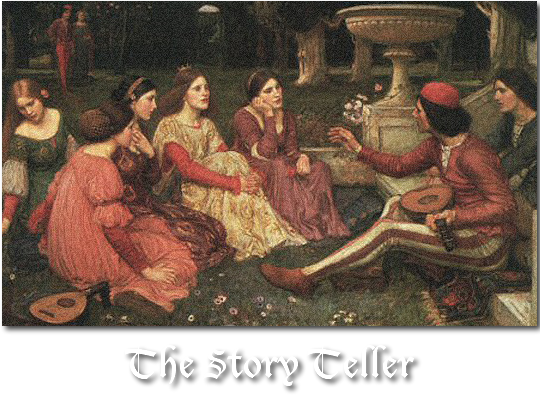
Using Google's reverse image search, I finally found the story behind my blog header. It was simply an image I had googled on Story Telling.


Now I found out that John William Waterhouse, a British Painter born in 1849 painted the painting after naming it "A Tale from Decameron". Decamaron is a medieval Italian story that describes how ten people (seven women and three men) ran away from their homes to escape the plague in Florence. As they fled through the countryside, they decided to tell ten stories each making a total of a hundred story. In all surviving texts, Bonaccio, the author was the first one to introduce the storyteller's story in a story! 


Coming back to John William Waterhouse, he painted this one nearing the end of his life battling cancer. He lived for his art and was recognised rightly so, thankfully, in his own lifetime.

I am really proud to have stumbled across this picture for my blog. I couldn't think of any other picture that could portray the basic idea of my blog, the power of stories any better. I think Google has come up with a wonderful concept. Also, as the title is a tale from Decamaron, I think the story teller is actually telling the story of another story teller!


Thursday, December 16, 2010

The War of Roses

My name is Margaret. Margaret of Anjou. I was fifteen then. I recollect those times in a haze almost. I remember sitting on the banks of Moselle with my grandmother, reciting stories. Stories of old, how she would keep Anjou out of the hands of the English, stories about the Hundred Years Wars and Joan of Arc. My mother too, when she had time to spare, would tell me of heroic battles that she had overseen when father was in prison, fighting for the the kingdom of Naples. Together, they taught me all they knew and I was blessed to be one of the most educated girl in all of France.


I was happy, truly unconditionally happy without any worries then. Until, William de la Pole, the soldier in the Hundred Years Wars approached my father for an alliance between Henry VI and me, Margaret of Anjou. At first, I was hesitant, after all the we have been fighting the English for Hundred Years! Soon, I learnt that this was a noble attempt to restore peace between the two nations and will restore Anjou and Maine unconditionally to French hands. So, with ideas of peace, I married Henry VI, King of England.

Little did I know then, that my lot in life was not peace.
I was the Quene of England.

Unfortunately, I could sense unhappiness among the English. Their people had been ravaged by war just as much as the French had. However, in their eyes, the French were at fault and my mere presence bore them a repugnance that was visible in those fawning eyes feinting flattery. I also donned a diplomatic mask and met these smiles with marked civility in court. I may be French by birth, but I had now dedicated myself to England, as is my duty to the Crown.

Richard of York


Five years after I married Henry, Richard of York had been named as the successor to the throne in absence of an heir. I was, well, confused. It was la Pole who explained all the politics that I was a stranger to.


Henry VI of Lancaster
My husband had ruled England since he was a mere baby, with regents acting on his behalf and incapable of taking decisions. We belonged to the House of Lancaster. Richard, from the House of York, claimed ascendancy to the throne based on an impressive family history. He explained to me that his actions had foiled an attempt to reconcile the rival dukedoms who had contemplated an inter-marriage. He told me about the corrupt courtiers that Richard had won and his gaining popularity.

I listened with interest. However, there was nothing to be said as the law required an heir and that the House of Lancaster did not have. Under William's  advice, I tried to remove him with the best assassins but he lived without doubt about his claim. That is, until my Edward was born in 1453. To my chagrin, Richard was named Lord Protector of the infant in light of the temporary mental illness that gripped Henry. On another line, both me and Henry had shared a dream of education and reformation and I set-up the Queen's College at Cambridge in his absence.

Soon Henry recovered and tactically removed the threat, Richard from the court.

Richard of York took arms in 1455 to fight for his right to the throne beginning a civil war.

An unrest had been simmering all along on the English loss in the Hundred Years' War, taxes and the famous Percy-Neville feud. Also, everyone swore their allegiance to their immediate lord, not to the respective side. It diluted power. English blood boiled, waiting to be spilled.

I observed all these factors and above all, this hatred rose in my heart against the one person, Richard of York. I wanted to secure the throne for my son.

The first battle took place at the capitol, St.Albans. We lost. Richard killed the powerful members of our side.  Henry collapsed mentally and was found in a tent quietly musing. Richard was once again Lord Protecter.

Both Houses were shocked at the bloodshed. They sought dialogue to come to a peaceful solution. I allowed my mask to fall. I made it very clear that Edward of Westminster, my son, is the next heir. Henry recovered and sent Richard to Ireland. We also moved away from the angry over-taxed merchants of London and set court in the country at Coventry. Slowly, we built our army through conscription, an order for all youth to participate in this civil war.

Oh yes, now I recollect that preposterous venture of Thomas Bourchier who celebrated Love Day in honour of complete peace between the two houses in 1458. Hostilities continued the next year when the deported Richard returned illegally from Ireland. After a loss at the Battle of Blore Heath, we won at the Battle of Ludford Bridge.

Seizing this opportunity, we ordered all the confounded members of the Yorkist faction attainted, that is denounced their noble blood status. Alas, they won at the Battle of Northampton in 1460 where Henry became a prisoner.

When Richard thought he had won, he was wrong. It was I who led the House of Lancaster now and may I say with pride, we won the Battle of Wakefield. Meanwhile, with many adventures, I had escaped to Scotland to protect the heir. I struck a chord with the Queen of Scotland and she agreed to send troops in exchange for Berwick-upon-Tweed for this battle.

Richard was killed in this battle and it was with great satisfaction that I ordered his head to let rot at the city of York.

Finally, I thought my child is safe.
How very wrong I was.

Richard had a son who had survived, Edward, who led the Yorkist forces now. We lost the Battle of Mortimer Cross due to his ludicrous superstitious speeches about seeing three suns. We won the Second Battle of St.Albans. I took particular pleasure in executing the two knights who were trying to ransom the king.


Alas! The biggest battle, the Battle of Towton, near York, we lost. Our family fled. The few surviving leaders changed sides. Edward of York beheaded John Clifford, my best man who had ,in turn, killed his brother.

Richard's son, Edward IV was crowned King of England. He married some Woodville, I cannot recollect. I think Elizabeth Woodville. Seeing the corruption and the rise in the nobility of the Woodville family, his most powerful and richest ally, the Earl of Warwick, a Neville, by the way, joined our side, bless him. My Edward married his daughter.

There were many, many battles after that. We won some, lost some. The King temporarily lost service. I draw now to the close of my story.

The Battle of Tewkesbury, 4 May 1471. I will not, cannot forget it. We had just returned from our long exile to join the triumphant forces only to realise that the news relayed to us, in Scotland, was out-dated. We entered into the battlefield.

My son, Edward, was killed.

After that, there was no spirit in me. The very reason for my existence just faded right in front of my eyes. I was imprisoned in England. Henry was murdered.

I was ransomed by the French king in 1475.

There is nothing left for me to add. I once again look at the clear waters of the Moselle only now they ripple with the faces of those long gone. In my haste to protect and honour the one life that I helped create, I do not know, how many I helped extinguish. I failed to realise the mortality of my own son's life. It seems ironic, that today, the 23 March 1480 marks half a century in my life and I have witnessed both the principalities of the war die, Richard and my husband Henry VI. I am old, so old, just living in total poverty through the sympathies of others. My son lived to see just seventeen summers. I stop my story here. May God forgive me, I think I have been punished enough.


This narrative is continued by Margaret of Lorraine, her niece after Margaret's of Anjou's death in 1482.

Well, news poured into France. Edward IV died of an illness. He named his brother Richard as Protector. Preparations were being made for his son's coronation. Richard had other plans, of course and murdered the 11 year old and the 9 year old princes in the Tower of London. He was crowned Richard III.


Henry Tudor, the Lancastrian candidate revolted at Buckingham against Richard which failed. Finally, Henry won the Battle of Bosworth field in 1485. Richard III was killed.

The House of Lancaster had won.

Henry Tudor, a man of infinite wisdom, married the daughter of Edward IV of York and created the Tudor line and was crowned Henry VII.

My aunt never lived to see the final victory. Henry VII joined the two symbols the Red Rose of Lancaster and the White Rose of York into the Tudor Rose ending the War once and for all. I think, historians will probably come to call it the War of the Roses. How ironic!

White Rose of York
Tudor Rose
Red Rose of Lancaster

In my opinion, the entire exercise was futile. The Richards, Edwards and Henrys were all killed. The ones who started this war were killed. Thirty years of Civil War from 1455 to 1485. England lost some of her best soldiers. The Battles were complicated and some times, chivalry was missing too. But as my aunt said, blood was boiling in English men, waiting to be spilled. They would have probably fought over another reason anyway. Peace exists now between and within England and France.

FINIS

Friday, November 26, 2010

The History behind the History

The first time I got interested in history was...

You are not going to believe it.

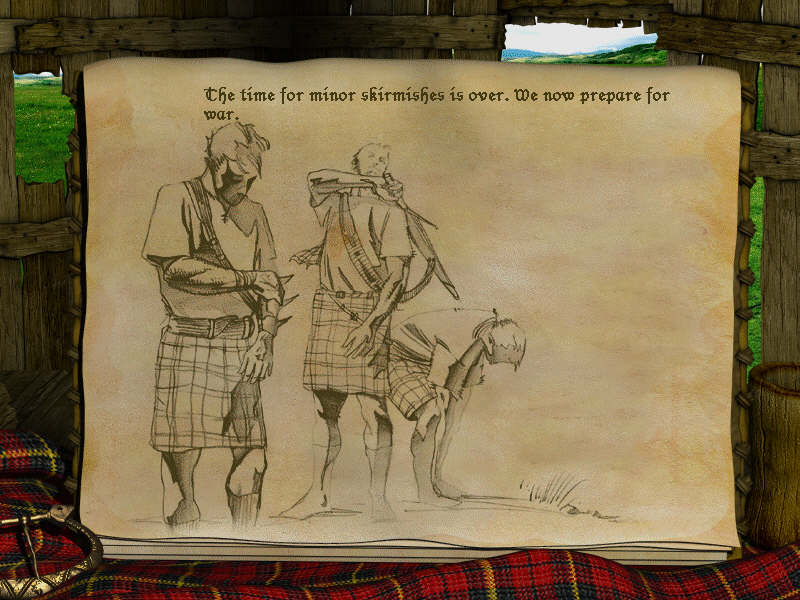
By playing Age of Empires II demo when I was really young, I don't remember exactly, maybe third I think.

The demo had only Learn to Play. I followed the story with real zeal. In fact, knowing the next part of the story was a welcome bonus and I often wonder, which gave me more pleasure, the “You are victorious', or the next part of the story. Even as I write, the Scottish accent fills my head with phrases like “Edward Longshanks, the avaricious king of Scotland” or “We are without a leader, the dead king of Scotland has no heir”.

The story of William Wallace. The game gives you the taste of unorganised Scotland before the entry of our hero. What I really liked was the inclusiveness you felt. William Wallace is their messiah bearing the torch of hope against oppression and subjugation. His battle techniques were quite unusual with wooden pikes to cover for their lack of cavalry. The Battle of Sterling and the Battle of Falkirk are covered. Of course, history tells us that William lost the Battle of Falkirk due to treachery whereas the campaign leaves with the victory over the English castle. The brutal quartering follows for our hero. The cause is taken up, twenty years later by Robert Bruce and Scotland wins.


The interest embedded was quite mild at that time. It really took off after this incident. My parents were seeing one of those English-dubbed-in-Tamil movies (Some of them are quite hilarious, Jackie Chan says “Naa singam, Nee asingam”). I sat down, with a familiar feeling. As I followed the story, I told them, “This is sort of like the game I play...” and I rambled on in my usual manner quite oblivious to their downright ignoring when

“and his name is William Wallace”.

“William Wallace” screamed the TV.

My parents were pleasantly surprised. “How on Earth did you know?”. “Its in my game...” And soon I had recited the whole story again. I got everyone excited and our entire family was a treasure trove of information on medieval Scotland. After that, it was no turning back. History was one of my favourite subjects.

My very first presentation was on William Wallace.